What Is a Gable Box? Its Benefits and Advantages Every Business Needs to Know
Some packaging formats address one problem very well. The gable box addresses a couple of issues. It contains the product, serves as a handle, is not taped or ribbed and is gift-ready off the production line. The gable box also has a combination of these that's not often found in a single folding carton style, which is one reason the gable box has been a staple in retail, food service and gifting for decades.
Gaining insight into the material, structure, and function of a gable box will enable companies to make an informed packaging decision before tooling. It is designed to provide information about the structure, advantages, final products and industries using the product most.
What Is a Gable Box?
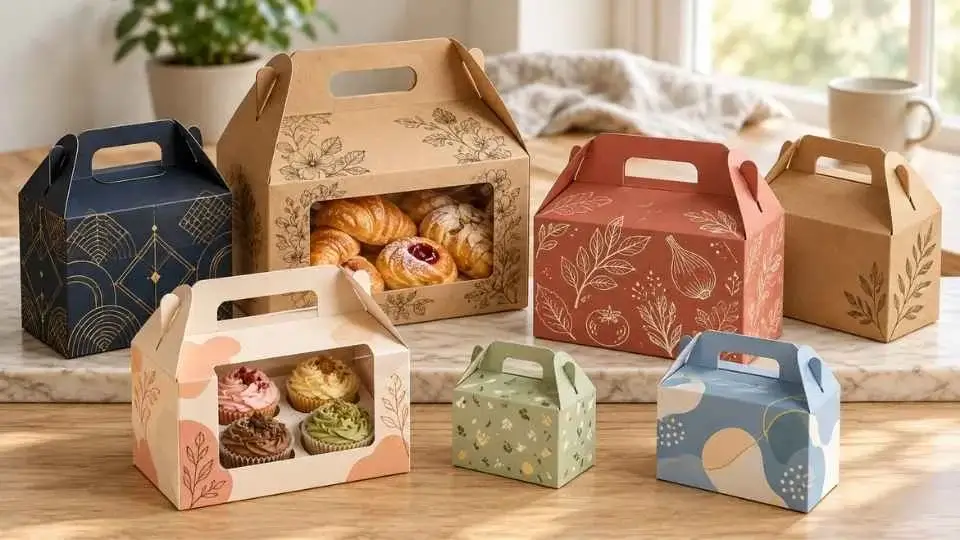
A gable box is a carton box that has a peaked top and folds into a built-in handle when the two roof panels are pushed together and fastened. The name of the structure is derived from the gable roof form which the top panels form when the box is assembled. It is flat cut off, stands up to form a rectangle with sloping sides and snaps closed at the top with interlocking flaps to form the handle. No ribbon needed. No handle component to attach.
The handle will be part of the die line. Assembled on a packing line, the box has a glueing plate on one side panel which is glued on before the box is sent flat, so assembly is quick — the box pops open, product is placed in and the top is glued closed in one motion. Gable boxes come in all shapes and sizes, from micro, single serve food sizes, to retail gift and carry out sizes. It is also used in the food industry as well as other non-food applications, further enhancing its versatility among industries.
How a Gable Box Is Constructed
The gable box die line includes a more complicated layout than a simple tuck-end carton, but this complicacy is what provides the structural benefits of the gable box carton. The panels are rigid rectangular bases which make up a rigid floor. The side panels slope inwards as they ascend to the top, giving rise to the sloped gable profile.
The top panels fold together and the flaps on the handles interlock to keep the box closed with no extra closure. Pre-glued side seam makes box easy to ship flat and is set up in seconds. Gable boxes are also important in board selection because the handle must be able to distribute the weight of the loaded box without ripping at the fold. Most food and retail gable box applications will use 18pt to 24pt SBS board.
Kraft board is popular in artisan food, bakery and farm-market applications where natural look is a part of the brand story. The standard for food-service gable boxes requiring a coated print face and an uncoated food-safe interior is C1S board — coated on one side.
The Built-In Handle Changes the Customer Experience
Most packaging formats require an additional element to be portable — a ribbon, a rope handle or a carrier bag. Portability is provided on the structure itself with the gable box. That automatic handle isn't a little something! It alters the interaction of a customer with the packaging when buying and when they are giving it away.
A customer is able to take a gable box from a shop without a bag. Gift recipient of something that is ready to present and move around. Reducing the ribbon or bag, simplifies packing and reduces per-unit cost for businesses. The gable box is a self-contained entity, a finished product, which expresses thought and care before it is opened to the customer.
Easy Assembly Reduces Packing Line Time
Time is of the essence on a packing line, especially on food service lines with high daily volume packing. The gable box fits together quicker than most carton boxes since the pre-glued seam eliminates folding and gluing before the box is in place to be filled. Only one motion will open it up. Product goes in. Locking of the top panels. The whole process is done manually in seconds per unit and is efficient when packed in a semi-automated packing station.
In the case of bakeries, delis and ready-prepared food operations using dozens or hundreds of packs an hour, the speed factor multiplies rapidly during a shift. If your retail gifting operation is engaged in a seasonal pack run, then fast assembly translates to more product being packed by a smaller staff without the extra costs of labor.
Versatility Across Product Types
Most businesses are unaware of the amount of product types in the gable box. On the food side, it's good for baked goods, popcorn, candy, dried fruit, small amounts of produce, and prepared food. As a retail and gifting outlet, it sells candles, bath items, small toys, stationery, cosmetic samples and branded items.
There is no insert required for the open interior, which allows the box to be adapted to whatever shape the product takes to fit into the cavity as long as it is not too heavy for the handle to support. If a product is too heavy (usually more than 500 grams) it's suited to a different format. The gable box, within this weight range, can have more product variety than virtually any other carton available today.
Print and Finish Options That Make a Gable Box Stand Out
The large, flat gable box surfaces are more printable than narrow surfaces of a tuck-end carton and the flat surface is seen from several directions when the box is placed on a shelf or display table. For food labels, ingredient panels and brand graphics, SBS board is the superior choice for offset lithography, featuring the highest print quality in terms of colour and text.
Gloss laminate brings pops and color for confectionery, children's products and seasonal gift uses. Spot UV on the logo or a graphic element is an effective process when applied onto the handle panel, as it creates a contrast that attracts the attention of the customer at the right moment, the time of gripping the box. In this group, which is the artisan and farm-market, Kraft gable boxes with low print and a hot-stamp or sticker label treatment are common, with the uncoated natural surface a part of the brand.
Retail Gifting and Seasonal Packaging
There are many reasons for gable boxes being the center of retail gift carry-out. They can be taken right up with the handle. The large panels are easily applied with seasonal graphics. The format is perfectly closed (no tape) so the gift reveal is neat and controlled. Gable boxes are ideal for packaging for Easter baskets, Halloween treat take-outs, Christmas gift boxes, and Valentine's Day gifts, when the volume is high, the gift context is clear, and the per unit cost must be affordable. Each run of this box has a different season's artwork on the same die line, so the box size is used for multiple season's programs without retooling. The versatility of the gable box makes it one of the most cost effective seasonal gift packaging formats in retail volume.
Food Service and Bakery Applications
Gable boxes are used for food that will be taken away from the bakery, patisserie, cafe, deli or catering service, and they certainly have a functional purpose, but they also have a pretty appearance. Gable boxes are good for cookies, macarons, brownies (in small portions), specialty popcorn, flavored nuts and more.
The peaked top prevents crushing the product as it would in a flat box with flat lid. The handle allows the box to be carried at level to diminish any tipping or shifting that could cause damage to delicate baked goods in transit. The proof coat is fully food-safe with a C1S board exterior coated with aqueous material, so that full-color printing can be achieved on the exterior panels.
Event Favors and Corporate Gifting
The gable box style is a common one in event favor and company present market. It has a handle that by design is a carry away favor, and there is no additional assembly required other than loading and closing the top. Custom printed gable boxes are used in corporate gifting programs for transporting branded items, food gifts, and special product sets to the conference, client or employee home. Brand identity is evident on the wide print panels.
The format fits nicely for assembly and ships flat, important for large corporate orders where space in the warehouse and shipping expenses are also part of the brief. The gable box is one of the most practical favor formats for event planners who are looking to use between 20 and 20,000 units, thanks to its convenience and impressive appearance, along with its reasonably priced per unit cost.
Why The Packaging Tree Specifies Gable Boxes From the Product Out
The Packaging Tree is not based on the standard gable box size, and doesn't begin by asking what product is going to fit into it. It begins with the product; the weight it places on the handle; the channel through which it is sold; and the brand impression that it strives to create — and it states the box from there. No pre-specified list of board caliper, coating type, print method and finish is used, but they are selected based on product and end use.
Before a physical sample run, the strength of the handle, closure fit, and print accuracy are all validated on the actual board. If the gable box is a seasonal workhorse for a brand, consistency in reordering is inherent in the production spec since the first order. The specification standard is applicable to a bakery, with 300 boxes per week, as well as to a corporate gifting program, with a requirement of 15,000 boxes for one event.